

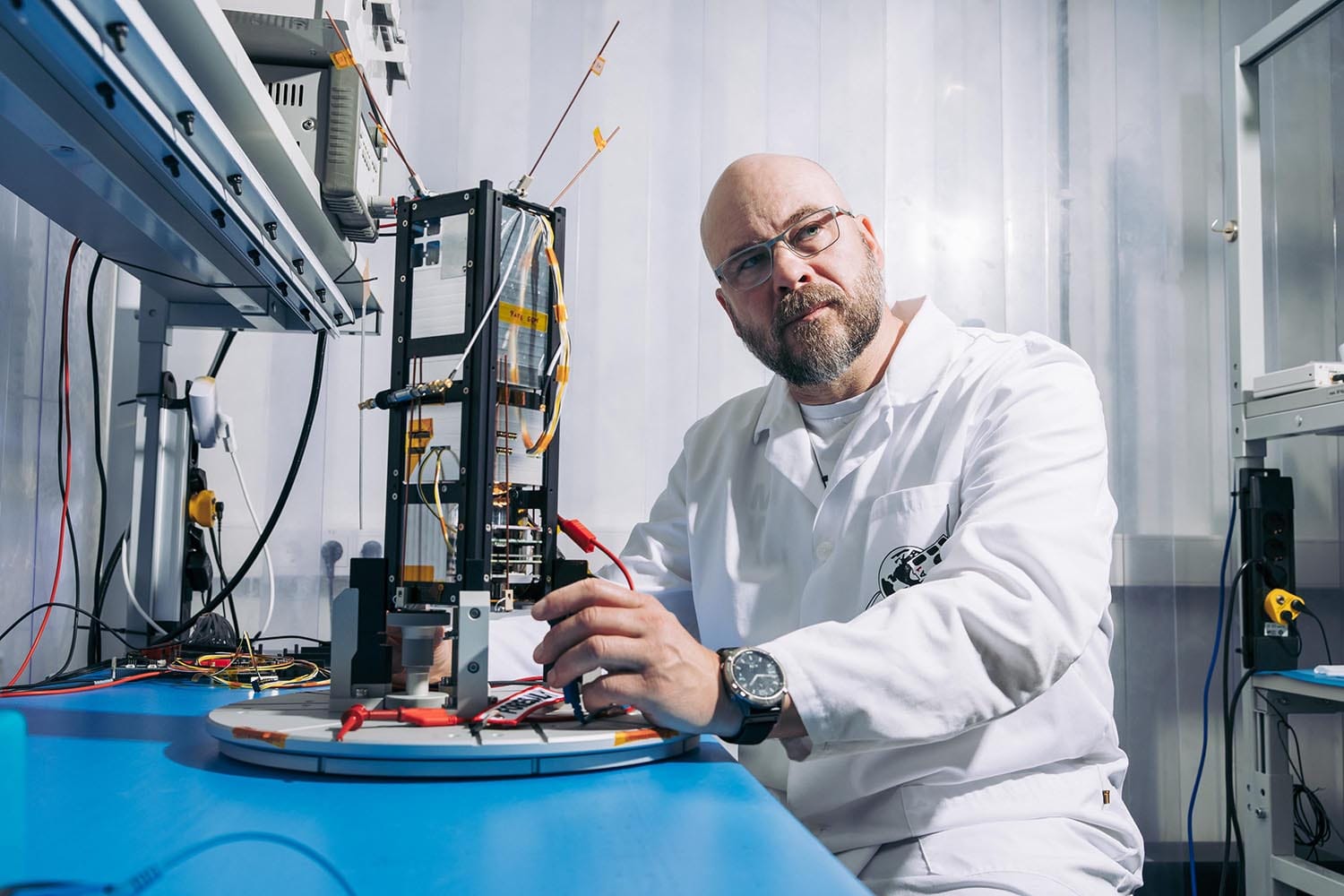
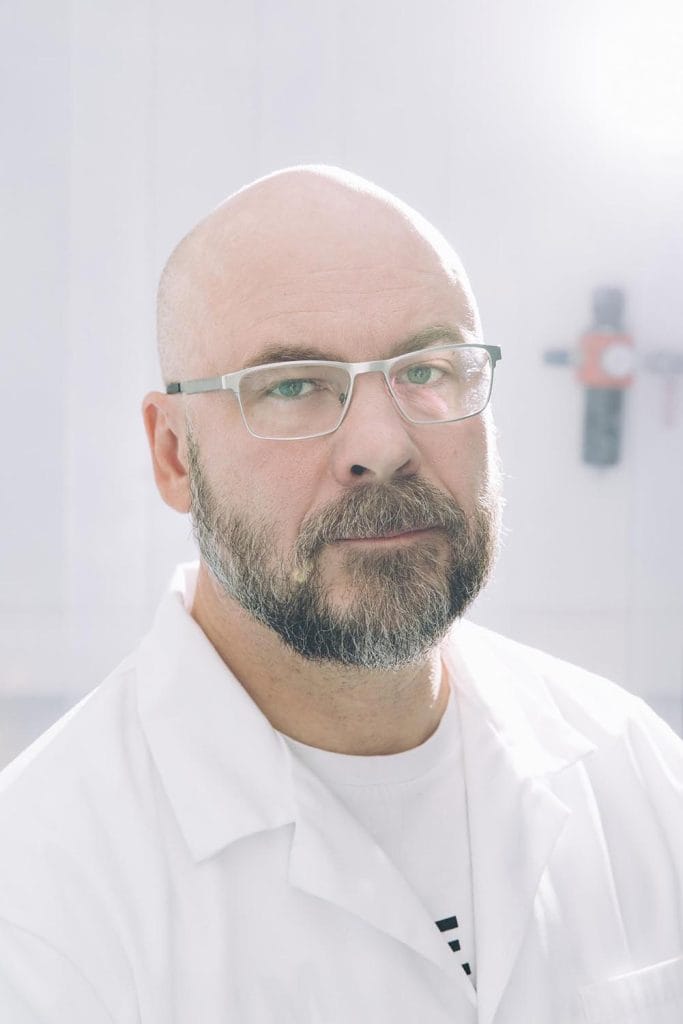
Professor Jaan Praks leads a space technology research group at Aalto University’s Department of Electronics and Nanoengineering. The Kordelin Foundation has honored Praks for his exceptionally impactful career as a pioneer of the Finnish space sector.
The atmosphere in Aalto University’s space technology laboratory is one of focused concentration. Three students sit quietly at their desks, building the university’s sixth satellite, Aalto-3.
One of them could be about to start the next Finnish space industry success story.
It would not be the first time. This very research group, led by Jaan Praks, has already given rise to several successful space technology start-ups – including Iceye, the satellite company already valued at 10.5 billion euros.
Praks says he finds working with young people inspiring: the pace is fast and the ideas are fresh. He wants to nurture his students’ ambition.
“Young, talented people need demanding projects and big ideas,” Praks says.
Finland’s First Satellite
As a young man, Praks did not dream of a career in space. He studied environmental physics at the University of Tartu, where his studies included remote sensing, which means the observation of nature and the environment using satellite imagery. Space technology was initially just a tool for monitoring the natural world.
Then chance intervened. Praks fell in love and ended up in Finland. He began his postgraduate studies at the Helsinki University of Technology’s space technology laboratory, researching radar imagery and aircraft-mounted measurement instruments for forest monitoring. When a position as a space technology lecturer opened in 2009, Praks applied and was appointed.
An enthusiastic group of students happened to sign up. Together we started wondering: what if we took the instruments used in aircraft and sent them into space?
“I was given responsibility for the introductory space technology course, which I set out to revamp. An enthusiastic group of students happened to sign up. Together we started wondering: what if we took the instruments used in aircraft and sent them into space?”
The planning and construction of Finland’s first satellite, Aalto-1, began. The University of Helsinki, the University of Turku, VTT Technical Research Centre and the Finnish Meteorological Institute all came on board. The shared enthusiasm is illustrated by the fact that not a single formal agreement was drawn up between the universities, and no money changed hands between institutions. Everyone was so focused on the work itself that bureaucracy was simply forgotten. Aalto-1, built largely by students, was launched into space in 2017.
According to Praks, the project proved that something this demanding could be achieved in Finland with student effort alone.
“Since there were no satellite manufacturing companies in Finland at the time, the students had to set them up themselves. Iceye and Kuva Space came into being and became pioneers of the small satellite sector in Finland and Europe. We got to be part of a growing space economy,” Praks says.
Small Satellites Changed the Space Industry
Aalto-1 was a small satellite, roughly the size of a large milk carton, built from standard electronic components. Over the years, more than a hundred active students took part in its development. The satellite followed what was at the time a new CubeSat standard, which made affordable launch slots possible and made the project significantly cheaper than its contemporaries.
“The CubeSat standard made it possible to build small satellites even in smaller countries, transformed how we teach, and opened up the satellite launch market,” Praks says.
Because small satellites are inexpensive to build, they also made it possible to construct and launch constellations of small satellites. Where a single large satellite could previously capture an image of Helsinki once a fortnight, a constellation of 20 satellites can do so daily. Today’s economic system demands continuous global situational awareness, something that only satellite constellations can provide.
Getting into space used to be difficult and required a great deal of money. The situation is now very different.
Congestion in Orbit
“Getting into space used to be difficult and required a great deal of money. Launches were infrequent and there were few satellites. The situation is now very different. Access to space is easy and no longer particularly expensive,” Praks says.
There are now as many as 15,000 satellites in space. According to Praks, some orbits are beginning to get congested.
“Satellites are now produced and launched in series. Old satellites cannot always be removed from orbit in a controlled manner, and this causes space debris to accumulate. The collision risk for satellites increases, and the operational lifespan of new satellites is threatened. The space debris problem could, through a chain reaction, spiral out of control and prevent us from obtaining valuable data such as weather information and a picture of the state of our climate,” Praks explains.
The large number of satellites and space debris burning up in the atmosphere may also add to atmospheric environmental risks. The aluminium contained in satellites in particular has been found to be potentially harmful to the ozone layer. The increasingly frequent rocket launches are also releasing new aerosols into the upper atmosphere, and we don’t fully understand the consequences yet.
Space compels humanity to cooperate. If cooperation and negotiation do not happen, the risk of collisions and radio frequency interference grows.
Every device launched into space shares its orbital altitude with the satellites of other nations. Isolation from others is impossible. Space is essential to humanity – for monitoring the Earth’s processes and keeping the planet habitable, among other things. Praks hopes that space will be used peacefully, not for conquest or military technology.
“Space compels humanity to cooperate. If cooperation and negotiation do not happen, the risk of collisions and radio frequency interference grows. An international legal framework is needed for the positioning of satellites,” Praks says.
Recognition for the Finnish Space Sector
Small satellites continue the story of the Finnish space sector, which stretches back over a hundred years to the aurora measurements at the Sodankylä Observatory. According to Praks, the general public has only recently come to realise that Finland has a thriving space industry at all. The Kordelin Foundation prize is, for Praks, recognition that his work has mattered.
“It always feels good when someone else gets something out of my tinkering. I am grateful and proud that my work has brought something of value to Finnish society and, I hope, to the broader development of the space sector. The future needs space and space technology.”